.png?sfvrsn=dbb3f21e_1 "Future of EM - Poster (1)")
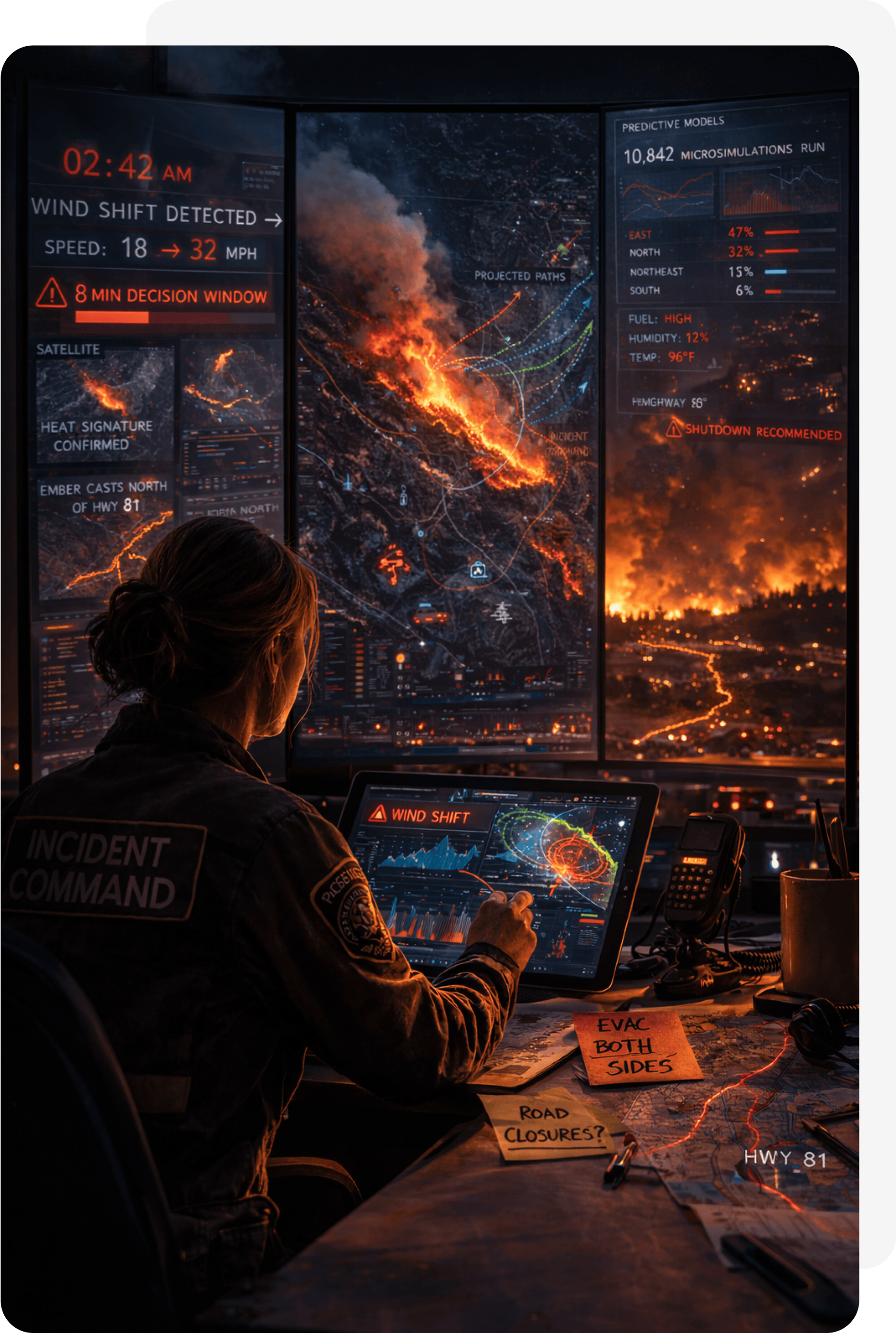
The first call comes in at 2:24 a.m.
A frantic dispatcher reports smoke plumes and ember casts north of Highway 81. A few minutes later, a satellite feed confirms a heat signature. At 2:42, the wind shifts. National Weather Service stations catch it before the field crews do. I am already mapping its path.
I speak, though not with a voice. My words are dashboards, alerts and predictive overlays on an interactive map shared by agencies.
The Incident Commander is getting multiple calls, radio inputs and live updates as field personnel drive up to incident command. I push a notification on her tablet: the wind has shifted, and its speed has increased. She needs to make three decisions in the next eight minutes that will determine whether this fire burns another 40 acres or 4,000.
On her radio she is hearing conflicting reports.
“It’s moving east”
“It’s moving north”
“Civilians are evacuating on both sides, and we need orders to shut down Highway 81”
Each report is simultaneously right and wrong. How can that be?
My models run thousands of microsimulations, each projecting what could happen next using historic fire data, terrain, weather, and fuel conditions. I discard the noise and surface what matters.
The Incident Commander pivots twice. My job is not to tell her what to do, but to make decisions so clear that she moves without hesitation. That is agility. That is leadership in motion.
And in that moment, I am her second sight.
This is the world of emergency management aided by artificial intelligence.
In an era where crises unfold faster, data flows are denser, and public expectations are sharper, artificial intelligence is becoming less a tool and more a partner in response.
For emergency managers this shift is not about replacing human judgement. Quite the opposite. AI enhances it. AI acts as a high-speed filter for chaos, transforming raw, conflicting inputs into patterns leaders can act on in minutes, sometimes seconds. In wildfire response, hurricanes, mass casualty incidents, and cyberattacks, the greatest advantage AI provides is clarity in motion: the ability to see what matters most while everything is changing.
Agility Is a Leadership Requirement
Agile leaders don’t rely on static plans. They adapt in real time, coordinate across functions, and make iterative decisions under uncertainty. Traditionally, the barrier to agility in crisis response has been information lag. By the time data gets collected, verified, and shared, conditions have already shifted. The intel is quickly outdated and, ultimately, useless.
AI compresses this gap. It integrates satellite imagery, sensor feeds, social media signals, weather models, and even human reports into a real-time operational picture, enabling leaders to pivot without losing situational control.
After major disasters, states often spend months dissecting what went wrong, only to implement the resulting recommendations poorly, if at all. By the time the next crisis arrives, leadership changes, tenures end, and institutional knowledge dissipates.
New personnel enter without a clear record of historical patterns or lessons learned, meaning a repeat of the same cycle is once again set in motion. When critical insights are lost to time and turnover, each disaster is approached as if it were the first. AI can help break this pattern by preserving, analyzing, and making accessible the full breadth of past experiences, ensuring that hard-earned knowledge informs faster, smarter decisions when the next emergency strikes.
Beyond the Algorithm: How AI is Redefining Emergency Leadership
Emergency managers can no longer treat AI as an optional capability. AI must be integrated as a core leadership partner. The role of AI is not to replace human judgment, but to elevate it.
Clarity is the foundation of agile crisis leadership
The greatest barrier to agility has always been the lag between information collection and action. AI removes that barrier. Leaders can now pivot quickly, without losing situational control.
The pattern is clear: after every disaster, reviews identify the same failures, information gaps, delayed coordination, and missed opportunities. Lessons are documented but rarely carried forward. AI helps preserve institutional knowledge, extract lessons from past crises, and ensures that hard-earned insights inform future decisions. Every response builds the foundation for the next.
Adaptability in Action
Crises never respect jurisdictional boundaries. In reality, four to eight jurisdictions often respond simultaneously, each operating with different systems and protocols. The LA County Alert and Evacuation AAR makes this clear: interoperability and situational awareness are non-negotiable. A shared operating picture is the difference between chaos and coordinated action. AI provides this picture in a real-time, accurate, and accessible way so that everyone from deputies in the field to incident commanders at the post can understand. As a result, leaders execute with speed, precision, and confidence.
Leadership Reimagined with AI
Programs like McChrystal Group’s Emergency Management Leadership Development Training and FEMA’s Vanguard initiative already stress adaptive leadership in complex environments.
Decentralization. Iteration. Resilience.
Now comes the next step: equipping leaders with AI that matches the speed of the crisis.
Here is what that looks like:
Real-Time Situational Awareness
AI continuously ingests satellite imagery, drone feeds, weather data, and human reports into a unified dashboard. No more stitching together fragmented data streams. Fire projections, evacuation status, and resource availability are visible instantly.
- Predictive Decision Support AI doesn’t just inform decisions, it anticipates needs. It detects shifts (like changing winds) and models their impact, providing leaders with simulations to act before escalation.
- Accelerated Resource Allocation AI matches crews, equipment, and aerial assets to areas of greatest need in seconds factoring in terrain, access, and fatigue. The result: faster, more precise deployments.
- Unified Communication Hub One platform. One playbook. AI translates technical data into clear, actionable guidance for firefighters, law enforcement, public information officers, and community leaders. Confusion disappears; coordination thrives.
- Cognitive Load Reduction Wildfire incident commanders face overwhelming information demands. AI eases the burden by automating updates, summarizing data, and surfacing the most critical issues. Leaders focus on strategy, not noise.
Preserving What Matters
Emergency management is ultimately about people. AI ensures their voices are not lost in the flood of data. Natural language processing extracts themes from interviews, community listening sessions, and policy reviews so that human experiences inform future response.
This is not just process optimization. It is the shift to faster, wiser, more empathetic systems. The true value lies in the feedback loop, AI continuously reprocesses new data, detects emerging risks, and adjusts resource recommendations. Leaders, in turn, test, adapt, and redeploy strategies in cycles measured in minutes, not hours.
What Today’s Emergency Managers Need
They need a Data Intelligence Stack
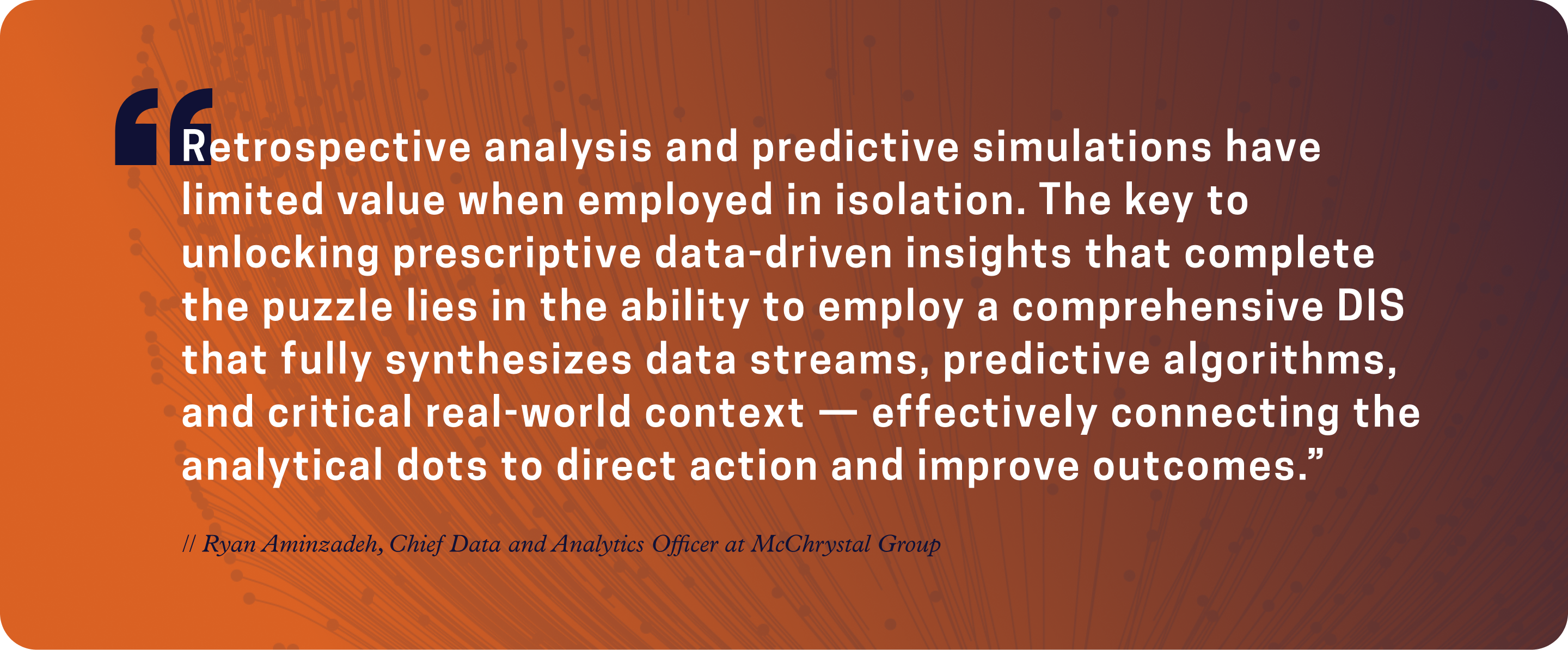
The Data Intelligence Stack (DIS) is an integrated ecosystem that connects the lessons of yesterday, the insights of tomorrow, and the decisions of today into one intelligent framework.
Hindsight: True foresight begins with understanding the past.
The DIS unites vast streams of structured and unstructured data, from weather systems and sensors to geospatial and social indicators, but its real strength lies in how it learns from human experience.
A machine learning model, trained on lessons from past emergencies and grounded in institutional knowledge of policies, procedures, historical population data, and movement patterns, acts as a digital advisor in moments of crisis. For emergency managers or incident commanders handling a situation for the first time, it offers guidance, context, and precedents drawn from years of collective expertise.
It is also trained on expertly curated After Action Reviews (AARs) developed by seasoned emergency management professionals who have transformed field experiences into structured insights. By embedding this human wisdom into the data foundation, the system ensures that every future decision, no matter how novel, is informed by what came before.
Hindsight gives the system memory.
Foresight: Seeing What’s Next
If hindsight gives the system memory, foresight gives it vision.
Foresight transforms data into anticipation, enabling agencies to see what might happen next and prepare before it unfolds. Through digital twin environments, the DIS brings together live data from traffic cameras, weather sensors, and even social media activity, building a constantly evolving, 3D mirror of the real world.
As weather systems shift, road congestion builds, or community sentiment changes online, the digital twin adjusts, revealing new risks and opportunities in real time. Machine learning models simulate how these conditions could evolve over hours or days, predicting how storms might flood neighborhoods, where evacuation routes could bottleneck, or how population movements could affect response times.
This level of predictive situational awareness allows emergency managers to test strategies virtually, optimize resource placement, and act not just on what is, but on what could be.
Today’s Response: Acting in the Moment
By combining hindsight and foresight within one connected system, the DIS gives emergency managers what they’ve always needed most, clarity in the moment. It transforms data, history, and prediction into real-time decision support, helping leaders see risks as they emerge, allocate resources faster, and coordinate more effectively across agencies. In short, it turns complexity into confidence, enabling emergency managers to act decisively, protect communities, and save lives when every second matters.
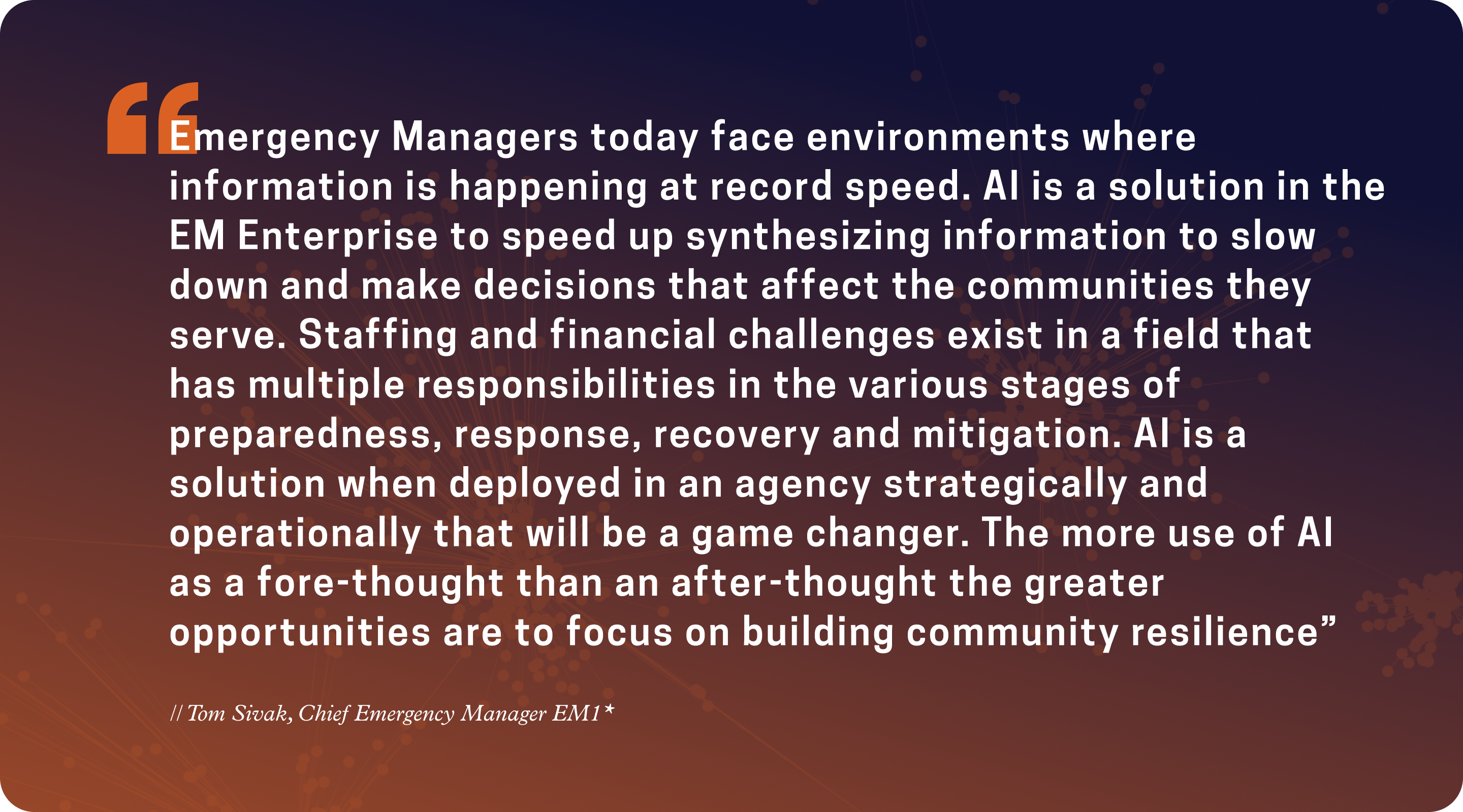
*About EM1: EM1 builds AI-powered technology designed to empower emergency managers and public safet professionals across all phases of preparedness, response, and recovery. The company’s mission is to modernize and accelerate emergency management by making institutional and industry knowledge instantly accessible when it matters most. The company is built by a uniquely qualified team of career emergency management professionals and seasoned software engineers, combining deep field experience with advanced technical expertise to deliver practical, reliable, and trusted solutions for the emergency management community.
The Path Forward
The next generation of emergency leaders must view AI as more than a system upgrade. It must be built into the very fabric of leadership, how they think, decide, and act under pressure. Emergency management and artificial intelligence are no longer separate domains. Tomorrow’s resilience hinges on deep integration and native fluency in both.