
Leaders are operating in an environment defined less by clear choices and more by persistent, unavoidable trade-offs.
The traditional playbook of optimizing for efficiency, driving growth, and executing strategy breaks down when competing priorities must be managed in parallel rather than "solved".
Executives are increasingly asked to navigate a paradox: be decisive and inclusive; move fast and build resilience; deliver near-term outcomes while investing for future advantage. The organizations that outperform will not be those that eliminate these tensions, but those that manage them deliberately through clear decision rights, disciplined operating rhythms, and consistent communication from the top.
Below are five leadership tensions many executive teams are navigating right now and practical strategies for helping your teams balance these tensions with clarity.
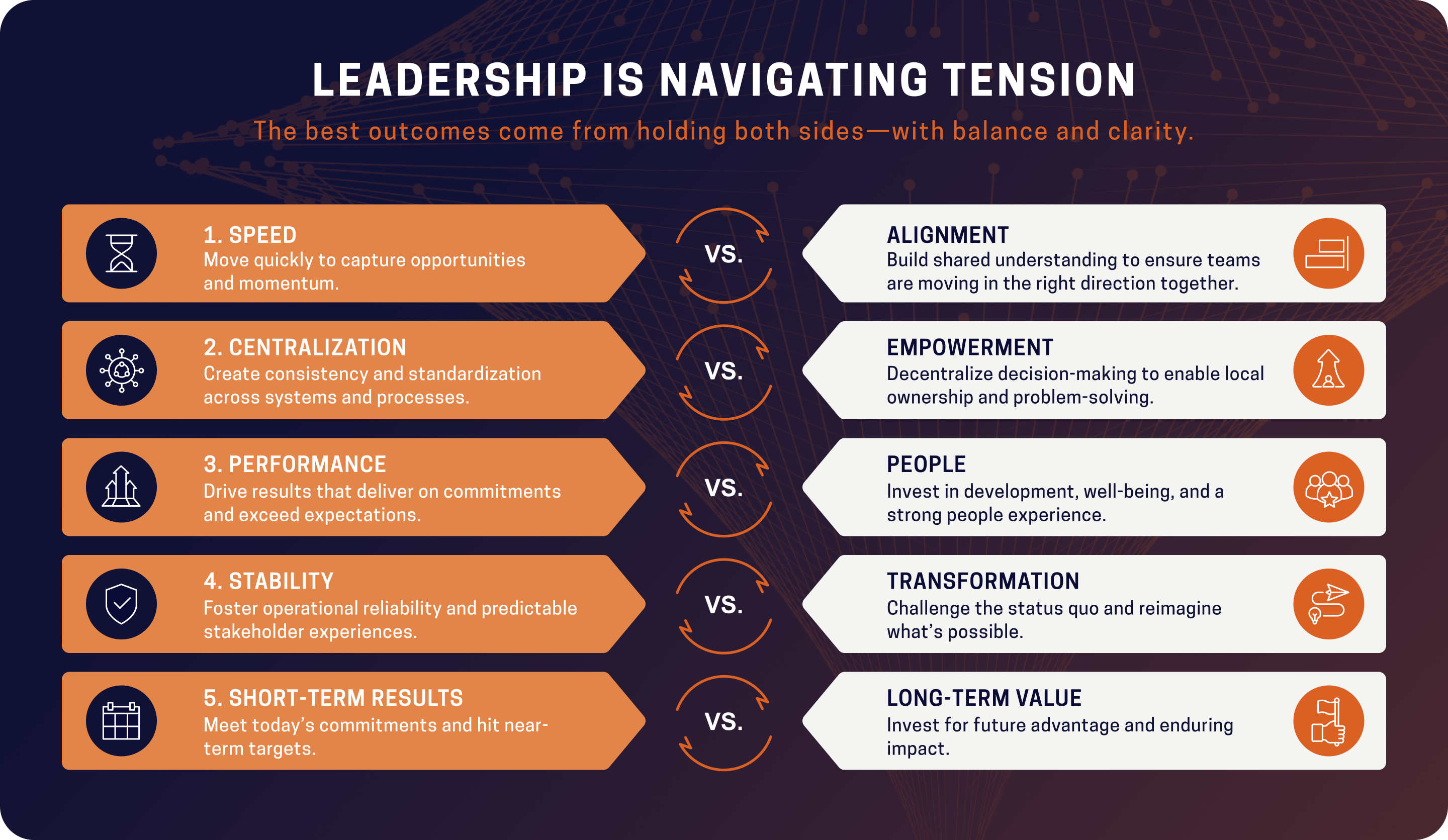
1. Speed vs. Alignment
The pressure to move quickly has never been greater. Markets are shifting rapidly, customer expectations evolve overnight, and competitive advantages are fleeting. Leaders are expected to act decisively and accelerate execution despite there being more interdependencies to consider than ever before.
At the same time, organizations have grown more complex. Decisions often require cross-functional coordination, stakeholder buy-in, and careful communication to ensure alignment. Moving too quickly can create fragmentation, while over-indexing alignment can stall progress.
Even speedy decisions that might be considered inconsequential and reversible require more alignment in a time when the public narrative moves quickly, and societal trust in corporate integrity is decreasing1.
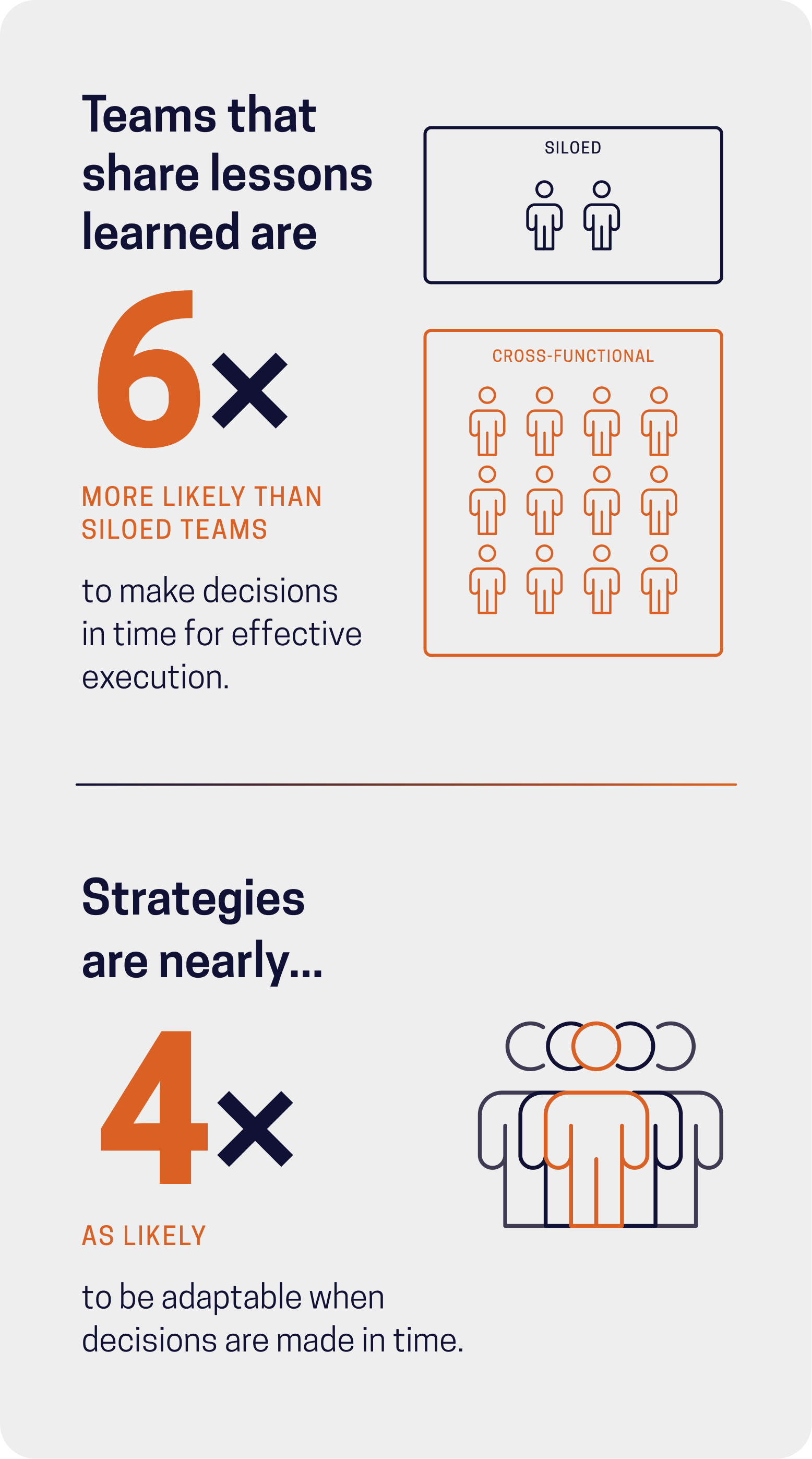
McChrystal Group found across 75,000 responses spanning all industries and organizational levels that when cross-functional teams are sharing lessons learned and best practices, decisions are 6× more likely to be made in time for effective execution. And when decisions are made in time for effective execution, strategies are nearly 4× as likely to be adaptable. This means cross-functional information sharing about how other teams have navigated risks and challenges is not only essential for fast decision-making; it's essential for executives to deliver on their strategic promises overall.
What executives can do:
- Establish clear information-sharing forums and expectations to surface interdependencies, challenges, and lessons learned.
The strongest leaders treat speed and alignment as interdependent. They codify decision rights, build shared context, and maintain simple communication rhythms (cadences, dashboards, forums) so alignment enables faster execution instead of constraining it.
Speed vs. Alignment in Action:
A COO at a global logistics firm is responding to a sudden supply chain disruption. One regional leader uses AI-driven forecasts to reroute shipments immediately, minimizing short-term delays. However, they do so without aligning with commercial and customer teams, resulting in missed contractual commitments and damaged client relationships. In contrast, another region pauses briefly to align across functions on priorities and constraints, slowing initial action but preserving key accounts and long-term trust.
Leaders navigating this tradeoff must consider the durability of customer relationships at risk, the reversibility of rapid decisions, and whether shared context is strong enough to enable decentralized action without fragmentation.
Another key element in getting the right balance between speed and alignment is identifying where decisions should sit so the organization can move fast without taking on unnecessary risk.
2. Centralization vs. Empowerment
As organizations scale, the need for consistency, risk management, and efficiency often pushes decision-making toward centralization. This tension is clearly adjacent to speed vs. alignment, because over-centralization both slows execution and decreases empowerment, but too much empowerment without clarity creates risk. In a complex environment, leaders often seek to standardize processes and maintain control as their default risk management tool. However, the pace of the environment in times of complexity demands that decisions be made closer to the front lines. Teams need autonomy to respond quickly and effectively to local conditions.
Artificial Intelligence (AI) is also intensifying this tension. It can generate recommendations and automate decisions at an unprecedented speed, but the value of those outputs depends on shared assumptions (inputs), governance (who can act), and judgment (how exceptions are handled). Without alignment on priorities and decision intent, AI accelerates activity without improving outcomes, amplifying noise rather than clarity.
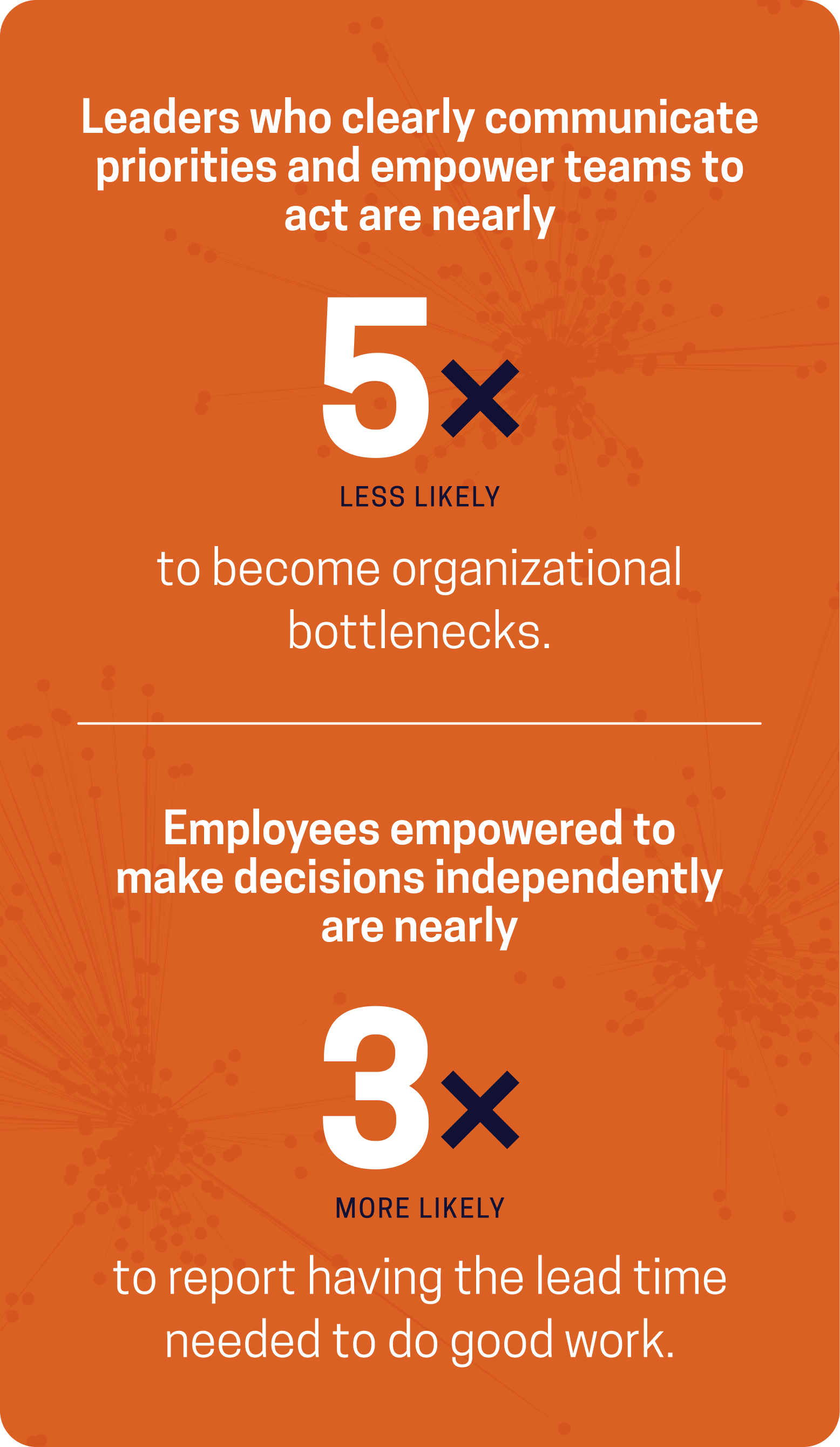
McChrystal Group research indicates that when leaders articulate their priorities to direct reports and let them act with that information, they are nearly 5× less likely to be cited as a bottleneck in the organization; and employees are nearly 3× as likely to report that they receive the notice and lead-time they need to do good work when they are empowered to independently make decisions.
What executives can do:
- Centralize what must be consistent, including strategies, values, risk thresholds, and critical standards, while deliberately delegating decisions to where information is richest.
- Establish decision criteria and escalation paths, clarifying which decisions are owned at which level and which are allowed to be algorithm-assisted versus human-owned.
- Use simple rules to establish clear and consistent guardrails to create confident decision-making.
Empowerment is not the absence of control; it is the outcome of explicit guardrails, capable teams, and trust reinforced by review mechanisms.
Centralization vs. Empowerment in Action:
A CEO of a rapidly scaling technology company faces increasing regulatory scrutiny across multiple markets. In response, headquarters centralizes decision-making to ensure compliance and consistency. This reduces risk exposure but slows product adaptation in key regions, allowing competitors to gain ground. Meanwhile, a business unit leader in another division operates with clearly defined guardrails and retains local decision authority, moving faster to meet market needs while staying within acceptable risk thresholds. She accepts that there will be a percentage of failure, and communicates to her team what failures are tolerable and which are unacceptable.
Leaders must weigh the organization's risk exposure, the clarity of decision guardrails, and the capability of frontline teams to operate autonomously without introducing unacceptable variability.
With alignment, speed, and empowerment addressed, the next tension is equally consequential: delivering results without degrading the very capacity that produces them.
3. Performance vs. People
Executives are under constant pressure to deliver measurable results like revenue growth, operational efficiency, and shareholder value. Performance remains a non-negotiable priority.
Simultaneously, expectations around employee experience have fundamentally shifted. Talent is more mobile, engagement is more fragile, and leaders are increasingly accountable for well-being, purpose, and development.
This creates tension: how to raise performance without eroding trust, increasing regrettable attrition, or burning out critical teams.
Leading through it requires redefining “performance” beyond output alone to include sustainability and capacity.
What executives can do:
- Narrow priorities and match workload to resourcing (even if this means some important things get deprioritized in the short-term).
- Equip managers to have honest trade-off conversations below the executive level (they can do this if you explain your decisions and ensure everyone understands what you are trying to accomplish and what you value most).
- Use leading indicators (engagement, retention risk, absence, quality defects, safety incidents) alongside lagging key performance indicators (KPIs) (revenue, margin, delivery).
For executives, the question is not whether to demand results; it is whether the operating model produces results repeatedly. When performance expectations, incentives, and capacity planning are misaligned, output can rise temporarily while capability declines.
4. Stability vs. Transformation
Organizations must continuously evolve to remain competitive. Digital transformation, new business models, and shifting customer expectations require ongoing change. Yet, constant transformation can destabilize teams. Employees need clarity, predictability, and a sense of continuity to perform effectively.
This challenge is compounded when the strategy-to-work connection is unclear. McChrystal Group research suggests only 50% of employees agree they have line-of-sight between their team’s goals and enterprise objectives, making sustained transformation harder to execute.
Leaders are therefore tasked with driving change while preserving enough stability for the organization to function. The key is not choosing between stability and transformation but intentionally designing both. This often means anchoring the organization in a clear purpose and core operating principles, while allowing flexibility in how work gets done. Stability becomes the foundation that enables transformation, not a barrier to it.
What executives can do:
- Reduce transformation fatigue by protecting a small set of “non-negotiables” (purpose, customer promises, technical expertise, risk standards, and a few core processes) while being explicit about what is expected to change (structures, technology, ways of working).
That clarity preserves stability and makes change feel coherent rather than constant. As transformation accelerates, the portfolio question remains: how do leaders allocate capital, attention, and talent across today’s commitments and tomorrow’s capabilities?
5. Short-Term Results vs. Long-Term Value
Quarterly performance pressures remain a defining feature of executive leadership. Stakeholders expect consistent, near-term results. However, many of the most important investments, such as talent development, innovation, culture, and capability build pay off over a much longer horizon. Leaders who succeed treat long-term value creation as a present-day operating discipline.
What executives can do:
- Make explicit portfolio trade-offs (run the business, change the business, grow the business) and protect a small set of compounding investments
- Communicate a clear narrative for why near-term concessions strengthen future performance.
- Align incentives so that leaders are not rewarded for short-term wins that create long-term fragility.
Short-Term Results vs. Long-Term Value in Action:
An SVP of Operations is under pressure to meet aggressive quarterly targets after a period of underperformance. They defer investments in workforce development and delay upgrading critical systems to protect near-term margins. The result is a strong quarter but increasing operational fragility and rising turnover over time. In a parallel division, another leader absorbs short-term margin pressure to invest in capability building and process improvements, leading to slower immediate results but a more resilient and scalable operation in subsequent quarters.
Leaders making this tradeoff should assess the organization's margin for short-term underperformance, the compounding impact of deferred investments, and how quickly capability gaps will begin to constrain future results.
Leading Through Tension, Not Around It
The defining challenge of leadership today is not solving for a single objective. It is managing multiple, often competing, priorities at once.
These tensions are not temporary. They are structural features of the modern operating environment. As such, they cannot be resolved once and for all.
Instead, leaders must build the capacity personally and organizationally to navigate them continuously. That includes tightening operating rhythms, clarifying decision rights, investing in shared context, and designing governance that enables both speed and risk control.
It also requires building the psychological safety and tolerance of tension necessary for leaders to have challenging conversations. Often, these conversations result in sacrifice and compromise, but the result is teams contributing to the best option for the collective.
In practice, this means routinely revisiting five questions:
Are we moving fast with enough alignment?
Are we driving performance sustainably?
Are we transforming without destabilizing delivery?
Are decisions sitting at the right level with clear guardrails?
Are we building long-term value while meeting near-term commitments?
Ultimately, the leaders who thrive will be those who embrace complexity rather than avoid it. They will recognize that progress does not come from choosing one side of a tension, but from skillfully holding both. In doing so, they position their organizations not just to respond to change, but to lead through it.
References
1 Michael W. Peregrine, “Corporate Governance, Trust and the ‘Crisis of Insularity,’”Harvard Law School Forum on Corporate Governance, February 12, 2026, https://corpgov.law.harvard.edu/2026/02/12/corporate-governance-trust-and-the-crisis-of-insularity/