In the world of big wave surfing, particularly at the famed Nazaré, Portugal, surfers often face unpredictable challenges.
Predicting waves relies on meticulous data analysis, underscoring the necessity of informed decision-making. The perfect wave only presents itself sporadically. Athletes like Garrett McNamara have turned their passion for riding these colossal waves into a canvas for understanding resilience, teamwork, and the pursuit of excellence. This endeavor invites us to ponder why we do what we do and what fuels our drive for success.
Surfers and business leaders share a common aspiration: to ride the crest of their potential and achieve the extraordinary. The history of surfing parallels that of entrepreneurship in that both reflect a journey marked by experimentation, risk-taking, and ultimately, transformation. Just as early surfers moved beyond solely using their senses and physical strength to chase the perfect wave, businesses today must navigate from rudimentary strategies to more sophisticated methodologies, leveraging technological advancements to propel themselves forward. The evolution of techniques and tools in both big wave surfing and entrepreneurship—from Laird Hamilton’s pioneering use of jet skis to businesses’ adoption of data analytics and AI—exemplifies this relentless human quest for expansion and understanding.
In pursuit of our dreams, whether they involve conquering the ocean or innovating within our industries, we can identify as either surfers riding the waves or castaways desperately trying to stay afloat while waiting to be rescued. Surfers use disparate information to challenge the status quo and take responsible risks in a complex and ever-changing environment. They seem to be consistently ahead of the curve, constantly adapting and leveraging their environment to ride the next wave of change. Meanwhile, many find themselves stuck in analysis paralysis, clinging to a life raft of hope: hoping to be saved, to win, or to understand. They undergo transformation after transformation, change after change, only to find themselves on another life raft. This type of leader is always “prepared for yesterday’s weather,” meaning they react to outdated, uncalibrated, and overly broad views of their organization.
The balance of being prepared and being willing to embrace risk can dictate the difference between the surfer and the castaway, an essential truth of leadership and growth.
By embracing the waves of change, we can foster resilience and, perhaps, grow the next generation of surfers, not castaways.
The Age of Understanding
The Information Age has come and gone. We now stand at the doorstep of the Quantum Age, an era defined not by the accumulation of data but by the speed at which we access, synthesize, create, and apply knowledge. As such, this next era could also be called the “Age of Understanding.” The challenge is no longer one of information scarcity but of the ability to make sense of a deluge of fragmented data streams. Those who overcome this challenge unlock a powerful advantage: a clear, comprehensive, high-resolution view of their organization, something we call organizational intelligence (OI).
An organization’s ability to adapt amid the accelerating pace of change is inextricably linked to its ability to harness and maintain this intelligence, as is the case with big wave surfers. Despite sitting on a treasure trove of data, most C-suite executives struggle to translate it into actionable insights. The problem isn’t access but coherence—the quintessential challenge for life rafts. True OI requires more than dashboards. It demands alignment, context, and the ability to connect dots across silos in real time, enabling the proactive leverage of information rather than making one a reactive observer of what that information portends after it comes to pass.
OI forms the bedrock upon which the Team of Teams® framework is built and sustained, providing the foundation for resilient, adaptable organizations. Unlike traditional models of knowledge management, which often emphasize data and systems, OI leans into the human element, prioritizing the collective knowledge and skills of an organization’s members. At its core, this concept highlights the importance of human connection. It recognizes that organizations are not merely aggregates of data or resources but vibrant networks of people whose interactions drive innovation and performance.
Harnessing the collective wisdom of team members is essential to unlocking the full potential of OI. But there’s a hard truth: achieving complete OI is difficult—maybe even impossible. There is no one-size-fits-all solution, no magic app that can seamlessly bridge gaps or instantly improve collaboration. The real power of OI lies not in tools but in trust. It emerges when employees at all levels are connected through shared context, open communication, and a culture that values transparency over control. In short, OI is not built; it’s cultivated. That cultivation begins with connection, not just between systems but between people. OI is inherently human. It’s shaped by relationships, shared experiences, and a deep sense of trust built over time.

Looking outside the boardroom can help us better understand OI’s power and complexity. Consider the dynamics of a big wave surfing team, where the surfer’s success relies not only on individual skill and technique but also on the seamless collaboration between the surfer and the jet ski operator. The latter must operate the machine in towering waves while anticipating wave patterns, making decisions based on multiple information streams, and adjusting in perfect sync with the surfer. The duo’s performance is enhanced by an invisible tether: an intuitive connection that transcends verbal cues and checklists.
This kind of synergy is rare in most organizations, yet it’s what makes OI so impactful and so difficult to replicate. It raises critical questions:
The answer begins with shared values and mutual understanding, the bedrock of effective collaboration. Without them, the potential for harnessing collective intelligence is significantly diminished. Research from institutions like MIT reinforces this truth: inclusive decision-making processes lead to enhanced group intelligence. These studies challenge the long-held belief that technical skills alone drive performance. Instead, they emphasize the roles of interpersonal skills, emotional intelligence, and psychological safety, especially among digitally or geographically distributed teams. The structural “DNA” of an organization—who is involved, how they interact, and the quality of their connections—profoundly shapes the organization’s capacity to develop OI.
Types of Intelligence: Past, Present, and Future
To truly understand OI, leaders must first understand how it relates to and differs from other forms of intelligence. OI doesn’t exist in isolation. It interacts with two other major forms of intelligence mechanisms: operational intelligence (OpI) and business intelligence (BI). Each serves a distinct purpose across varying time horizons: past, present, and future.
But intelligence isn’t valuable on its own; it must be timely, relevant, and consumable at all levels of the organization. Insights that are misaligned with decision-making rhythms or buried in dashboards become noise.
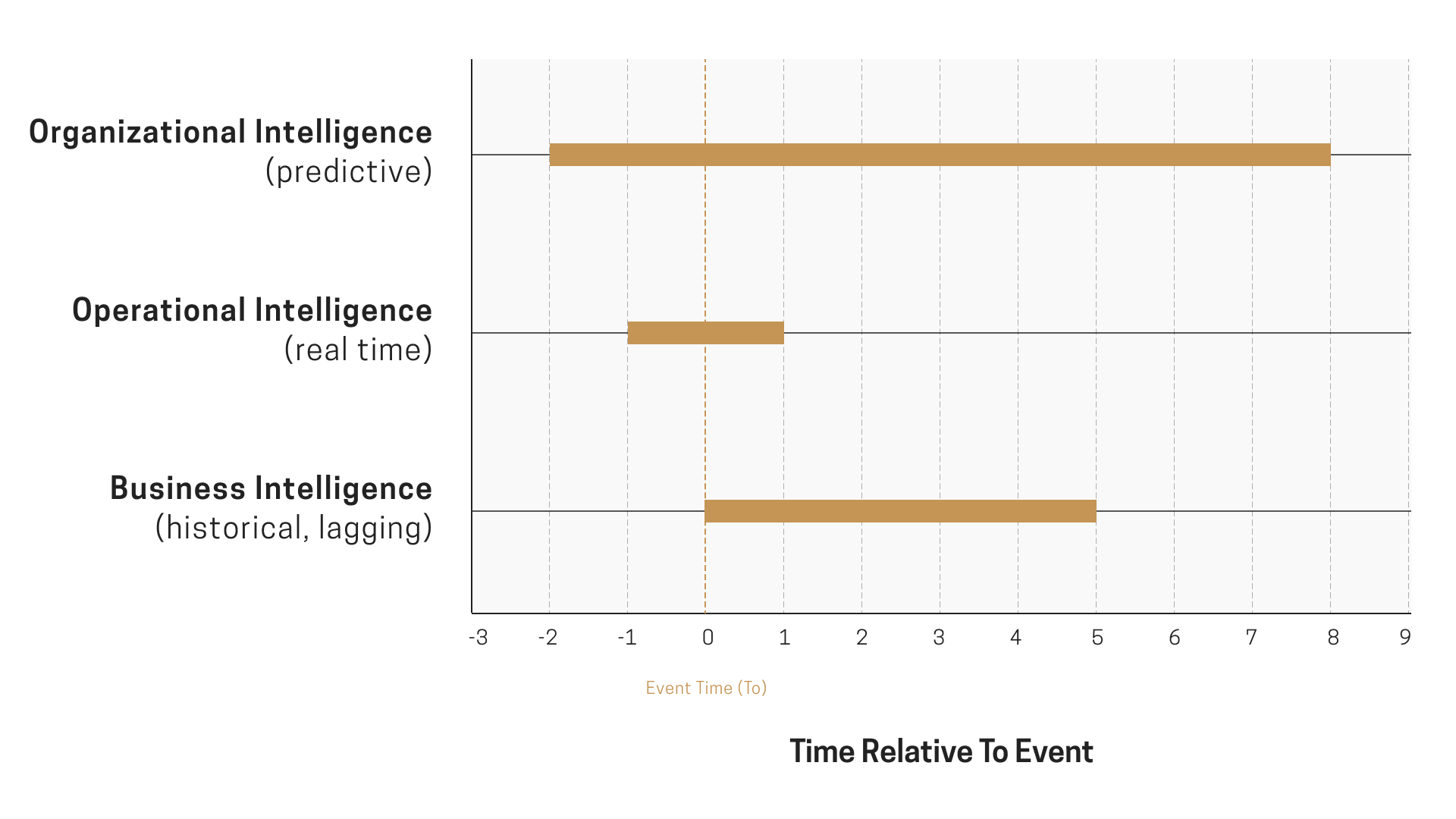
BI serves as our guide to the past, offering insights based on historical data and financial metrics. Like a historian, BI helps leaders draw upon previous events for trend analysis and long-term strategies. However, relying solely on this historical perspective can often diminish the relevance and effectiveness of insights in rapidly changing environments.
Meanwhile, OpI is our companion in the present. It delivers real-time insights into processes and performance, enabling swift course correction amid shifting conditions. While valuable for daily execution, it rarely offers the foresight or alignment needed for organizational optimization or transformation.
OI incorporates historical data while looking ahead, bridging the analytical with the human perspective. It integrates emotional intelligence, sentiment, and intangible cultural dynamics that often influence an organization’s success. This long-term outlook allows companies to “see around corners”—spotting trends, interpreting leading indicators, and recognizing patterns in how the company has reacted in the past. In this way, effective OI does more than inform decisions; it shapes a culture of proactive adaptation. It equips leaders to anticipate rather than react, align rather than command, and foster an environment where resilience and agility become default behaviors, not aspirational goals.
The Pillars of Organizational Intelligence
With this multi-layered understanding of intelligence in place, we can now shift our focus to OI. Through closer examination, we will uncover how OI acts as the backbone of resilient and adaptable organizations, guiding them through times of change, volatility, and risk and ensuring sustained success in a constantly changing landscape.
Pillar 1: Targeted Data Acquisition
The first step toward OI is not collecting more data—it’s acquiring the right data. Targeted data acquisition identifies, prioritizes, and captures the most valuable content and contextual signals from across myriad systems, silos, and sources. Vexingly, the data with the most value is the most difficult to acquire. It’s buried in systems, trapped in workflows, or held in the thoughts and behaviors of frontline employees. This is the first and often most persistent barrier to OI.
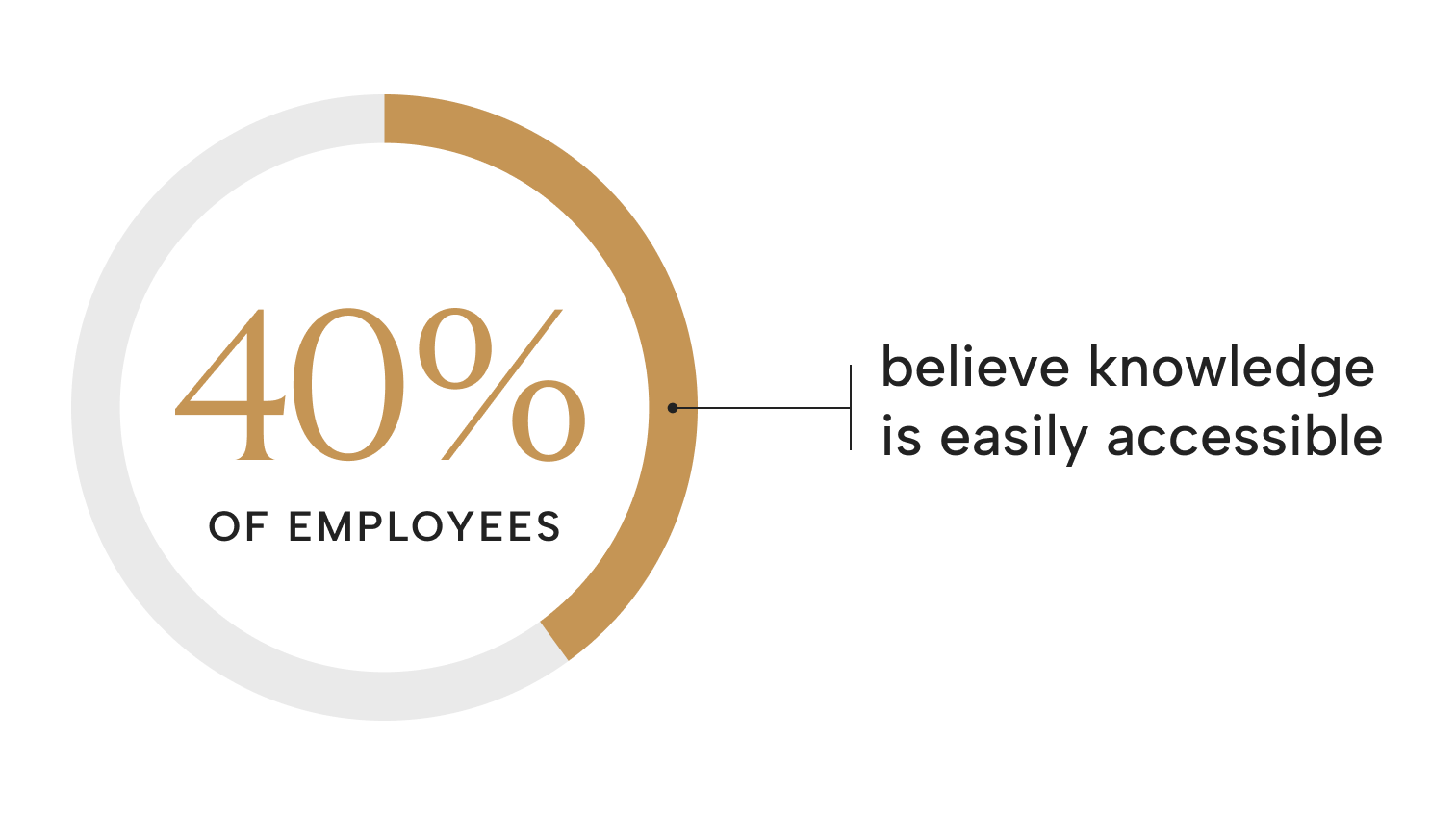
McChrystal Group’s decade-long analysis of organizational networks and leader behaviors revealed that only 40% of employees believe knowledge is easily accessible. That lack of access has real consequences. Our research shows that when company knowledge is easily accessible, employees are over four times more likely to report that decisions are made in time for effective execution. Thus, it is crucial to make organizational knowledge visible, shareable, and actionable where and when it matters most.
Pillar 2: Synthesis and Analysis
If targeted data acquisition is about surfacing the right pieces, synthesis and analysis are about assembling them. This pillar transforms fragmented data points into a holistic picture of the organization: past, present, and future. This means storing and structuring information so it’s accessible across the organization while connecting the right data to extract and action at the enterprise level.
The power of OI lies in the patterns that individual data points reveal when viewed in context. Effective synthesis and analysis requires both discipline and design. Leaders must be deliberate about which data to integrate and how to interpret it, distinguishing true signals from misleading noise.
When done well, this pillar enables reliable, real-time insights that span teams, systems, and silos. But when poorly executed, it invites risk. Undisciplined analysis can overwhelm teams with redundant or irrelevant data, delay critical decisions, or drive action based on false assumptions. In the age of AI and automation, over analysis is an easy temptation.
The organizations that can distill complexity into clarity and insights into impact will always have the advantage.
Pillar 3: Value Capture
No matter how sophisticated the data or advanced the analysis, OI only delivers impact if insights are actionable, accessible, and aligned with decision-making. This is the essence of value capture, which ensures that insights translate into outcomes and fuel a shared consciousness across teams.
The way intelligence is visualized, reported, and disseminated determines the difference between “interesting” and “meaningful.” OI supports a Team of Teams operating model only when insight delivery matches tempo, structure, and decision-making processes. Dashboards alone are not enough. Real operational clarity comes from creating a common operating picture and a dynamic, shared consciousness that empowers everyone from the C-suite to the front line.
This doesn’t mean centralizing every data stream into a single dashboard, which often leads to overload and dilutes the message. Instead, a Team of Teams approach emphasizes decentralized stewardship: frontline operators and subject-matter experts become both data contributors and insight consumers. By capturing context at the edge and enhancing it through structured feedback loops, organizations create intelligence that’s timely, trusted, and tailored to action.
Value capture depends on lightweight but enforceable governance, ensuring data quality, consistency, and relevance from the moment it’s generated. These structures reinforce a culture of trust, where contributors at all levels know their insights are valued and will be acted upon. Practices such as daily standups, cross-functional huddles, and after-action reviews maintain a common purpose and alignment without introducing unnecessary bureaucracy. These rituals help build a culture of trust in which contributors know their insights are valued and used.
Rather than relying on a single analytics hub, organizations should invest in common taxonomies, communities of practice, and analyst rotations across business units to share knowledge and contextual nuance. When everyone speaks the same data language, intelligence flows more freely, and teams make faster, more coherent, and more confident decisions.
Effective value capture means integrating insights into daily workflows: mobile dashboards, chat-based alerts, and AI-driven agents that surface the right information at the right moment. Closed-loop feedback systems ensure that performance data informs future improvements, turning the organization into a network of intelligence hubs, each contributing to a unified, adaptive, and high-performing whole.
Ultimately, value capture is about turning insight into action and embedding intelligence into the daily rhythms of the organization. Intelligence becomes a living system when frontline operators and subject-matter experts become stewards of both inputs and outputs. Context-rich information is gathered at the source, enhanced through feedback loops, and delivered through intuitive platforms. The result is a distributed network of intelligence hubs, each enabling faster and better execution.
This kind of operational clarity doesn’t happen by accident. It takes intentional leadership capable of turning complexity into clarity, especially in high-stakes environments. That’s why we sat down with Erin Sutton, a leader who has consistently turned complexity into clarity through decisive action and systems-level thinking.
Operationalizing Organizational Intelligence
Erin Sutton, former chief deputy state coordinator for the Virginia Department of Emergency Management (VDEM), was responsible for managing daily operations and driving key organizational and digital changes within the agency.
When Sutton stepped into her role, she was no stranger to volatility. From hurricanes and hazardous material incidents to the Virginia Beach mass shooting and the COVID-19 pandemic, her team was constantly operating in conditions where perfect information was impossible and timing was everything. The only way to move at the speed of crisis was to ensure that insight flowed freely, that decisions were distributed, and that every node in the network—field teams, local partners, and public health agencies—could operate from a shared understanding.
“Emergency managers aren’t just responders; we’re integrators,” Sutton said. “We build a picture from incomplete information and help others act, even when the full picture hasn’t come into focus.”
That philosophy mirrors the three pillars of OI in practice. To acquire the right data during Virginia’s response to the pandemic, Sutton’s team worked closely with the Virginia Department of Health and local responders to gather real-time operational metrics, using tools like Survey123 to collect input directly from the field.
“We didn’t need more data—we needed the right data, at the right time, from the right people,” she explained.
To meet that challenge, VDEM embedded liaison officers in local jurisdictions and standardized data-collection tools to gather critical insights on vaccine inventory and logistics constraints. That information was then layered with GIS mapping tools to proactively identify service gaps and adjust resource allocations in real time.
Once collected, that information had to be synthesized fast. During COVID-19, VDEM migrated and unified its digital infrastructure to streamline procurement, financial tracking, and reporting systems that had previously lived in silos. This enabled more rapid analysis, improved resource allocation, and a unified view of operations that cut through the fog of response. The agency still uses these systems to this day.
Born in crisis, the real power came in value capture, which continues to translate insight into decisive action. VDEM trained more than 2,800 personnel, executed over 40 exercises, and rapidly deployed funding to localities. Operational clarity wasn’t reserved for senior leaders. Instead, it was embedded at the edges where action occurred.
Sutton credits much of the team’s success to maintaining a battle rhythm that mirrored the dynamics of a Team of Teams environment: clear roles, transparent communication, decentralized execution, and relentless iteration. During daily standups, Sutton’s team validated field data with local reps before integrating it into statewide planning.
“We designed our system so the frontline had a voice and the people closest to the problem were equipped to solve it,” she said. “That’s what enabled us to respond at scale without losing situational awareness.”
Sutton’s reflection reinforces a critical insight for any leader: OI isn’t just a data strategy but a leadership system. It requires trust, shared consciousness, and the ability to put people and insights into action across an entire ecosystem. In high-stakes environments, whether in emergency management or enterprise transformation, organizations embed OI into their operating model to stay ahead of change instead of being overwhelmed by it.
“It wasn’t just about collecting numbers,” she noted. “It was about closing the loop and making sure our decisions directly supported what was actually happening on the ground.”
Unlocking Organizational Intelligence for Lasting Impact
In both the public and private sectors, leaders face increasing pressure to collect data and turn it into sustained impact. OI prioritizes value over volume by breaking down silos, surfacing insights that matter, and embedding those insights into decision-making and action. The challenge lies in operationalizing three tightly connected components: targeted data acquisition, synthesis and analysis, and value capture. 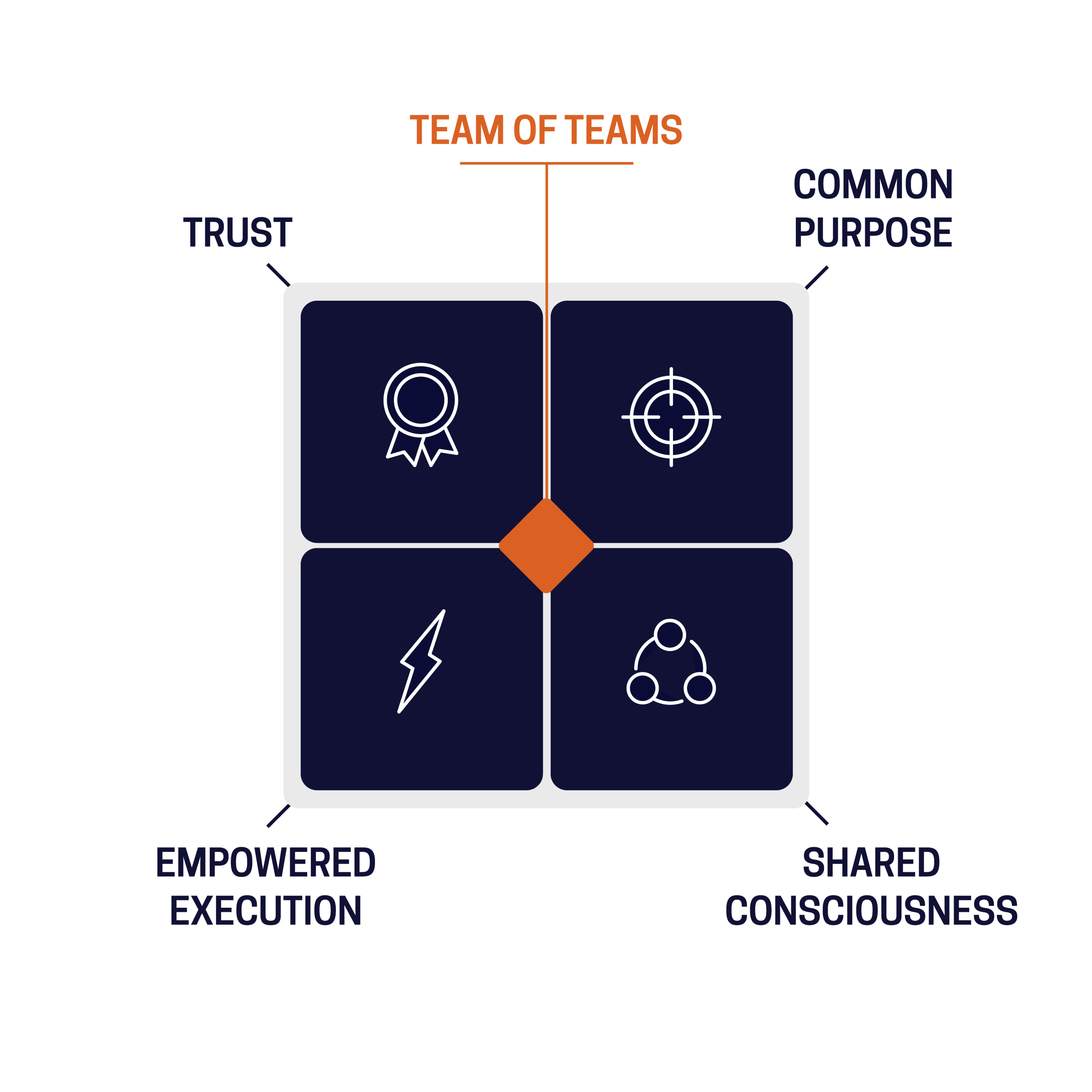
The Team of Teams® framework, introduced a decade ago, remains a powerful blueprint for navigating these challenges. Its emphasis on shared consciousness, empowered execution, and trust enables organizations to harness OI not as a dashboard but as a system for adaptability, resilience, and high performance.
This brings us back to the world of big wave surfing. Much like surfers navigate the unpredictable forces of a 70-foot swell, modern organizations must operate with real-time awareness, decentralized execution, and seamless coordination. Big wave surfers also don’t ride alone. They rely on a network of forecasters tracking distant storms, spotters perched on cliffs, a jet ski pilot guiding them, and drone operators providing real-time visuals. Success lies not in one person’s judgment but in the system’s ability to share intelligence and move as one.
Targeted Data Acquisition: Breaking Down Silos
Data fragmentation remains one of the most persistent barriers to OI. Critical information is often locked in silos, stored in inconsistent formats or legacy systems, or isolated from other valuable datasets. This fragmentation hinders shared understanding and impacts decision-making. To combat this challenge, organizations must build unified, flexible data architecture.
Information must flow freely across business units, platforms, and geographies. In the surfing world, meteorologists, satellite systems, and ocean buoys work in tandem to forecast conditions days or weeks in advance. This reflects the organizational need to pull together predictive models, market trends, and operational inputs to anticipate disruptions before they occur.
And just as big wave surfers don’t paddle out without first analyzing swell forecasts and ocean conditions, high-performing organizations must rely on both external signals and internal telemetry to anticipate risk and opportunity. This positioning requires more than centralized command—it demands a Team of Teams® approach to data governance.
This involves building cross-functional data stewardship teams that ensure data quality, security, and compliance while also empowering individuals at all levels to take ownership of technical accuracy and contextual relevance. The goal isn’t just to standardize data but to humanize it.
Organizations reduce misalignment and improve collaboration by developing a shared data vocabulary that bridges functions and departments, thereby enhancing overall collaboration. Like a surf crew that reads the ocean in sync, teams aligned around common definitions and mutual trust can move faster and more decisively, regardless of what’s over the horizon.
Synthesis & Analysis: Make Collaboration the Default
Once data is connected, the challenge becomes turning it into actionable insights. This requires powerful tools and culture of collaborative sensemaking. Team of Teams taught us that decision advantage comes not from a single node but from enabling every team to operate with clarity and autonomy.
In the lineup at Nazaré, the surfer is not just reacting; they are processing a wave’s shape, speed, and threat in real time. The jet ski pilot coordinates timing, feeds critical cues, and becomes the lifeline if things go sideways, acting much like an organizational integrator. Behind the scenes, spotters and drone operators provide critical visual intelligence, scanning for threats and opportunities.
This mindset can be applied to data analysis. Organizations should democratize access to analytics tools, enabling teams from different functions to engage with data directly. CIOs and digital leaders are no longer just cogs in the machine but critical business leaders tasked with enabling the digital literacy of the organization to enable this direct, real-time interaction with data.
Organizationally, this is what real-time analytics and cross-functional teams achieve. CIOs transform from gatekeepers into enablers of flow, ensuring that data scientists, strategists, and frontline experts operate with synchronized clarity. Data-driven decision workshops, forums, or meetings, much like pre-session surf briefings, examine insights collaboratively, ensuring they inform operational decisions and become a key component of the organization’s operating rhythm.
Capturing Value: Bridging the Insight–Action Gap
Insight without action creates drag. To unlock OI’s full value, organizations must ensure that intelligence not only informs but transforms.
That means embedding insights into workflows, surfacing the right cues at the right time, and enabling decentralized teams to act confidently without waiting for top-down directives.
This is the heart of the surfing analogy: The surfer makes decisions at 80 km/h, but they’re not acting in isolation. They trust the system, the jet ski operator, the forecast, and the warning signals to support and enable their execution. In a high-functioning organization, frontline operators are empowered surfers who are equipped with data, trained to respond, and supported by systems that deliver clarity, not complexity.
To make this work, organizations must design incentive systems that reward insight-driven behavior and establish feedback loops that reinforce learning. Team of Teams emphasizes the role of rapid adaptation through continuous monitoring and distributed decision-making. In both waves and work, riding once is not enough—you must reset, recalibrate, and be ready for the next set. Key performance indicators and feedback loops are essential in reinforcing this. Continuous monitoring enables and encourages adjustments to the strategy based on real-time data and outcomes, fostering a culture of innovation and resilience.
From the Beach to the Boardroom: A Comprehensive Approach for Lasting Change
By methodically addressing the three pillars of OI—targeted data acquisition, synthesis and analysis, and value capture—organizations unlock more than operational efficiency; they unlock resilience, clarity, and speed. Rooted in the principles of Team of Teams, this approach transforms how leaders move from a static command-and-control structure to a dynamic, empowered one fueled by shared understanding.
In a world defined by volatility, most organizations aren’t failing because of a lack of data but because they’re clinging to life raft mindsets. They react to the waves of disruption only after they’ve been hit, are struggling to stay afloat, and are disconnected from the information and coordination needed to move with intent.
But high-performing organizations think—and act—more like big wave surfers. They’re constantly scanning the horizon, interpreting signals, and adjusting in real time. Their success isn’t based on avoiding risk but on harnessing it through shared consciousness, trust, and empowered execution. With OI in place, they ride waves others didn’t even see coming.
This isn’t just a framework but a new operating model for a new era. And those who embrace it won’t merely survive waves of disruption—they’ll define what comes next.
Resources
Insights